
Source of wealth vs source of funds
They sound similar, but they answer two different AML questions. Source of wealth asks how the customer built up their overall wealth. Source of funds asks where the specific money used in a transaction came from. Understanding both is essential for effective KYC, CDD and ongoing monitoring.
At a glance
- Source of wealth: how a person accumulated their overall wealth. The focus is long-term financial history.
- Source of funds: the origin of the specific funds used in a transaction. The focus is short-term and transaction-specific.
- Both should be plausible and consistent with each other and with what you know about the customer.
- How much evidence you need depends on the customer's risk.
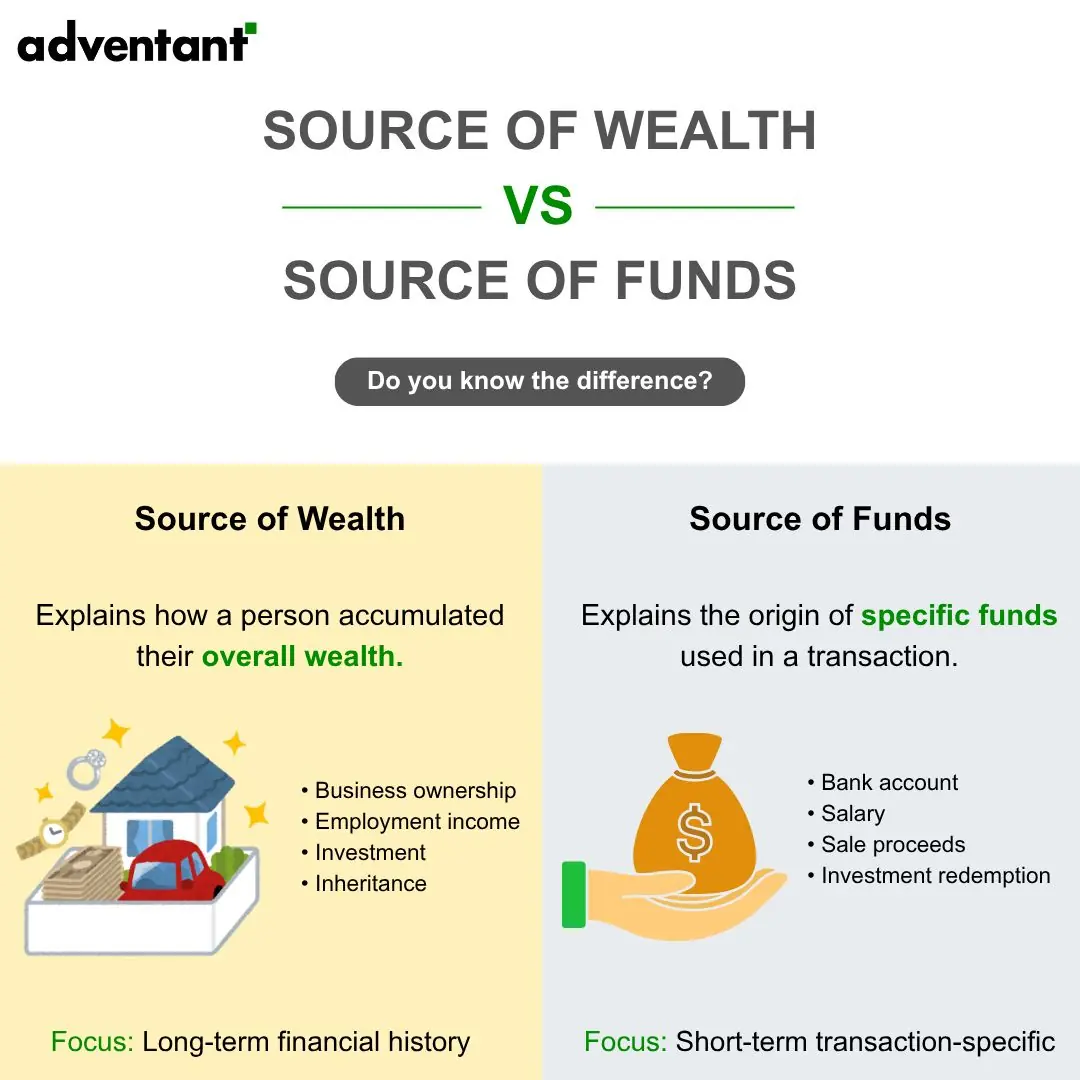
Source of wealth looks at long-term financial history. Source of funds looks at one transaction.
The detail, step by step
Ask the right question
Source of wealth: how did this customer come to have what they own? Source of funds: where did the money for this particular transaction come from, and how did it reach you?
Source of wealth: typical origins
Common explanations for overall wealth include:
- Business ownership.
- Employment income.
- Investments.
- Inheritance.
Source of funds: typical origins
Common explanations for the money in a transaction include:
- A bank account held by the customer.
- Salary.
- Sale proceeds, such as from a property or a business.
- An investment redemption.
Check that the story holds together
The funds for a transaction should make sense against the customer's overall wealth. A modest salary and a large cash purchase, for example, need an explanation that can be supported.
Scale the evidence to the risk
For lower-risk customers, a reasonable explanation may be enough. For higher-risk customers, including PEPs, you would expect supporting documents such as bank statements, sale agreements or company accounts.
Record and revisit
Record what the customer told you, what evidence you saw and your conclusion. Revisit it when the customer's activity or profile changes.
Mistakes to avoid
- Treating source of wealth and source of funds as the same thing.
- Accepting a one-word answer such as 'business' or 'savings' for a higher-risk customer.
- Collecting documents without checking that they support the explanation.
- Not linking the funds in a transaction back to the customer's known wealth.
Evidence to keep
- Recorded source of wealth and source of funds explanations on the customer file.
- Supporting documents for higher-risk customers.
- A note of how the reviewer assessed plausibility.
- Updates made when the customer's profile or activity changed.
Where Adventant can help
General information only, not legal or compliance advice. The examples and figures are invented for illustration. Your obligations depend on your activities and your regulator, so check the current rules that apply to you or speak to Adventant about your situation.