
Your customer passed KYC. So why is the payment still blocked?
Passing KYC does not always mean a payment will go through. KYC checks the customer. Cross-border payments face further compliance checkpoints along the way, at your bank, at correspondent banks and at the receiving bank. It is not just about the customer. It is about the whole payment journey.
At a glance
- KYC is the beginning, not the end, of the checks a payment faces.
- Sanctions screening, country risk, correspondent bank checks and transaction risk indicators can each stop a payment.
- Enhanced due diligence may be needed for higher-risk payments.
- Clear, complete payment information and good records help payments move.
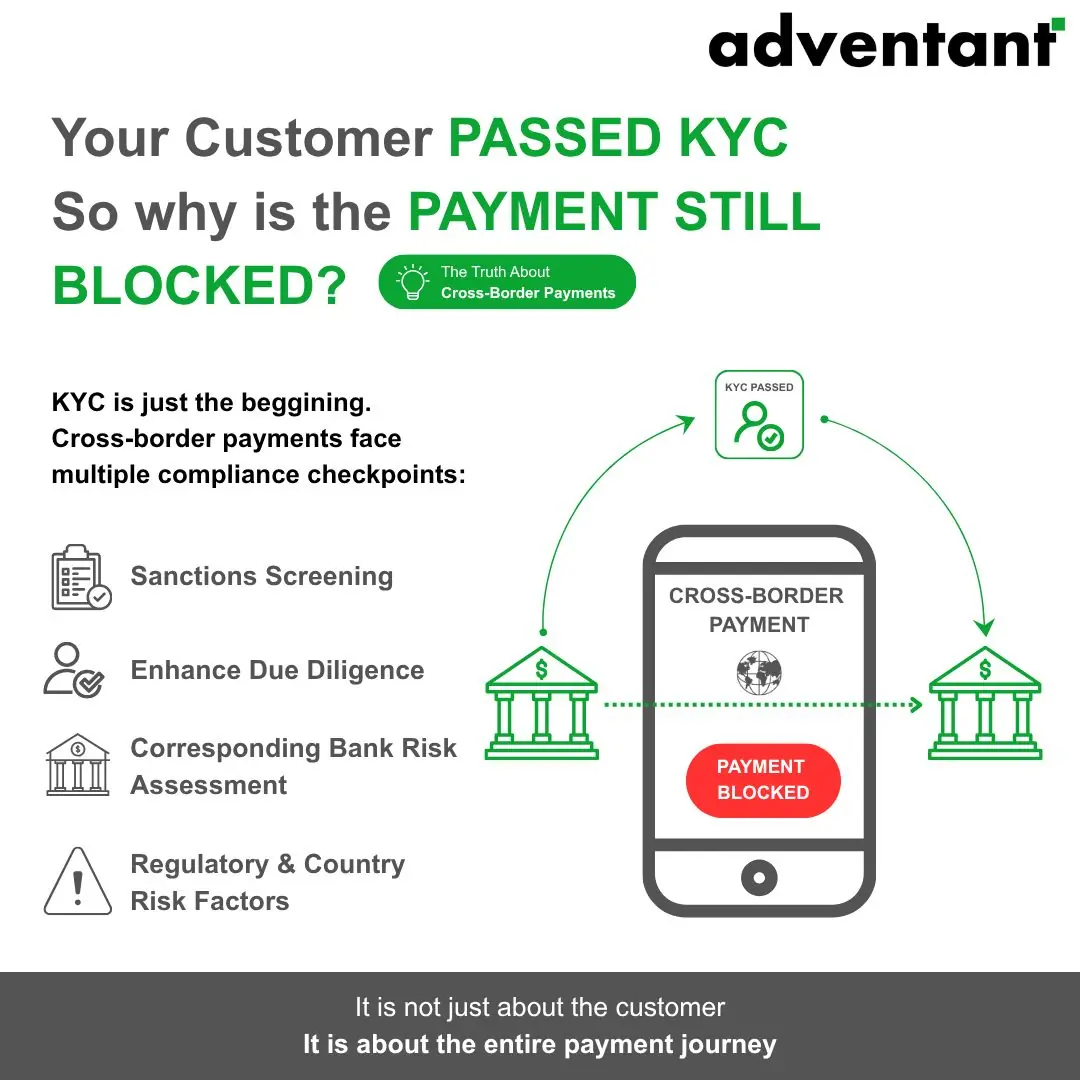
A verified customer, a cross-border payment and the checkpoints in between.
The detail, step by step
KYC checks the customer
Onboarding establishes who the customer is, who owns and controls them, and what business they do. That is the base for everything that follows, but it does not approve each payment.
Sanctions screening
Each payment can be screened for the parties, banks, vessels and places involved. A possible match, even a false one, can hold the payment until it is cleared.
Country and jurisdiction risk
Payments to or through higher-risk jurisdictions may face extra questions or restrictions, depending on each bank's policy and the rules that apply to it.
Correspondent bank checks
Cross-border payments often pass through one or more correspondent banks. Each applies its own controls and can ask for more information before it lets the payment through.
Transaction risk indicators
Banks look at whether the payment fits the customer's known activity: the amount, the purpose, the counterparty and the pattern. Something unusual can trigger a review.
Enhanced due diligence where required
Higher-risk payments may need more: supporting documents, an explanation of the purpose, or evidence of source of funds. Having these ready shortens delays.
Mistakes to avoid
- Assuming a customer who passed KYC will never face payment checks.
- Sending payments with vague or missing purpose information.
- Not keeping invoices and contracts ready for bank queries.
- Ignoring repeated payment holds instead of asking what is causing them.
Evidence to keep
- Complete KYC and beneficial ownership records.
- Supporting documents for significant or unusual payments.
- Sanctions screening results and how possible matches were cleared.
- Records of bank queries and the responses given.
Where Adventant can help
General information only, not legal or compliance advice. The examples and figures are invented for illustration. Your obligations depend on your activities and your regulator, so check the current rules that apply to you or speak to Adventant about your situation.