
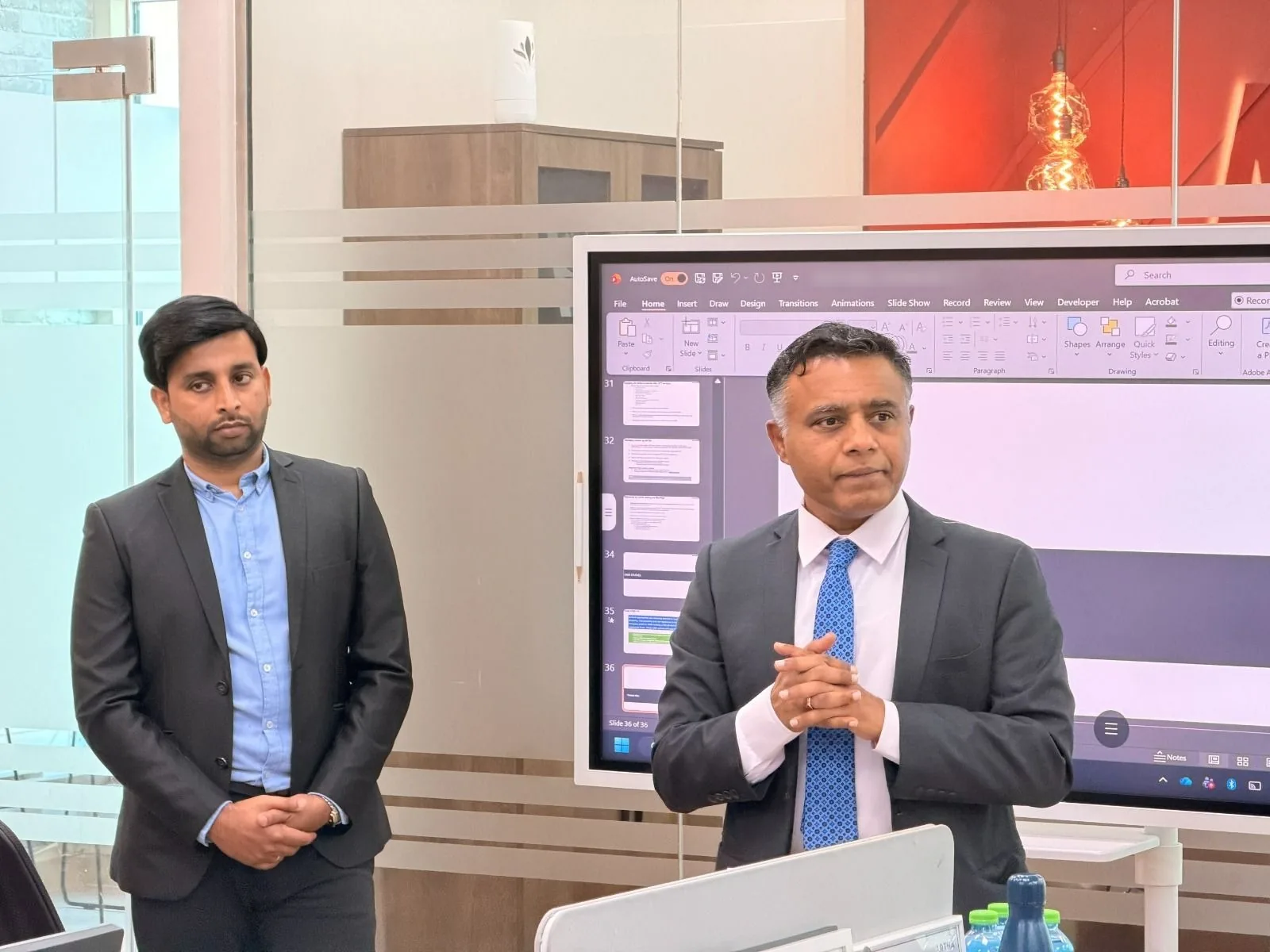
In-House AML Training for Your Staff in the UAE
Regulated UAE businesses must train their staff on AML obligations and on their own procedures, and keep records that prove it. Here is who needs what, what inspectors ask to see, and how we deliver it.
In-house AML training for staff in the UAE is training built on your own firm's policies, risk assessment, red flags and escalation route, delivered to each group of staff according to their role, and evidenced by a training register, dated attendance records and assessment results. It is a separate thing from a personal certification course such as CAMS or ICA. Adventant designs and delivers it for regulated businesses across the UAE, with the records an inspector expects to see.
- Federal Decree-Law No. 10 of 2025 and the supervisory rules require regulated businesses to train staff on their AML obligations and on the firm's own procedures, not just on general concepts.
- Front-line staff, compliance staff, senior management and the board each need different content, and inspectors expect to see that difference reflected in the plan.
- What inspectors ask for is evidence: who attended, what was covered, when, how understanding was tested, and when the refresher is due.
- A CAMS or ICA certificate held by one person does not discharge the firm's duty to train everyone else on its own risk assessment and red flags.
- Adventant delivers role-based sessions built on your policies, with sector-specific red flags, short assessments, a training register and an annual plan.
Who this is for
This page is for owners, general managers and compliance officers of UAE-regulated businesses who need in-house AML training for staff in the UAE that will actually stand up at inspection. Most of the firms we train are DNFBPs supervised by the Ministry of Economy and Tourism, and a smaller number are financial institutions under the CBUAE, SCA, DFSA or FSRA. Typical situations:
- A real estate brokerage or precious metals dealer that has written AML policies but has never run a training session, and now has an inspection notice or a self-assessment questionnaire to complete.
- An accounting, audit or company service firm whose only training record is one person's CAMS or ICA certificate, with nothing for the rest of the team.
- A firm that has been told at inspection, or by an independent reviewer, that its training was generic, undated or not linked to its own risk assessment.
- A board or senior management team that has never been briefed on its own AML responsibilities and wants a short, direct session before the next regulatory interaction.
Why in-house AML training for staff in the UAE is an obligation, not an option
The UAE's current AML law, Federal Decree-Law No. 10 of 2025, requires every regulated financial institution and DNFBP to put in place internal policies, controls and procedures proportionate to its risks, and to make sure its staff understand and apply them. The supervisory rules issued by the Ministry of Economy and Tourism, the Central Bank, the DFSA and the FSRA each spell this out as a requirement for ongoing employee training. Our MoET AML law guide sets out the mainland framework in more detail; for the text of your own supervisor's rules, check the current published version.
Three points matter in practice. First, the duty sits with the firm, not with individual employees. Second, the content has to cover the firm's own procedures: its customer due diligence steps, its risk rating method, the red flags relevant to its sector, how to escalate an internal suspicion and who files on goAML. Third, the firm must be able to prove that the training happened. Inadequate staff training is one of the compliance failures for which a Supervisory Authority can impose administrative penalties, which under the current law range from AED 10,000 to AED 5,000,000 per violation, alongside warnings and licence measures. See our note on AML fines and penalties in the UAE for the full framework.
Who needs what
A single all-staff presentation does not meet the requirement well, because the people in the room have different jobs. We separate training into four audiences:
- Front-line and client-facing staff: brokers, sales staff, relationship managers, reception and onboarding teams. They need to recognise red flags in their own daily work, collect the right documents, and know exactly who to tell and how, without tipping off the customer.
- Compliance and operations staff: the compliance officer, MLRO, deputy and anyone who does screening, risk rating, record keeping or goAML filing. They need depth on the firm's procedures, the sanctions and PEP screening process, and the reporting workflow.
- Senior management: the owner, partners and department heads. They need to understand their accountability, how the business risk assessment drives the controls, and what the inspection and penalty regime means for them personally.
- The board or equivalent governing body: a short, factual briefing on oversight duties, the MLRO reporting line, and what they should be asking to see each year.
What inspectors ask to see
In our experience of inspections and remediation, the questions on training are consistent. Inspectors ask for the training policy and annual plan, the attendance records with names, roles and dates, the materials actually used, the results of any assessment, the induction process for new joiners, and evidence of a refresher cycle. They also check that the content matches the firm's business risk assessment and its written procedures. Training that cannot be dated, or that covers money laundering in general but says nothing about the firm's own customers and products, tends to be recorded as a finding. Our inspection readiness checklist covers the surrounding documents.
What Adventant does
A training engagement is scoped in advance so you know what is included, how many sessions there are and what records you will hold at the end. The steps below describe a typical engagement for a single-entity DNFBP. Larger or multi-licence groups are scoped separately.
- Review of your documents (typically week 1). We read your AML policies and procedures, your business risk assessment, your customer risk rating method and any previous inspection or review findings. If these documents are missing or weak, we say so, and we can address them through our policies and procedures and risk assessment services before training begins, because training staff on procedures that do not exist is not useful.
- Audience mapping and training plan. We agree which staff fall into which audience group, the session length for each, the delivery format (on site in Dubai, online, or a mix for staff in other emirates) and the dates. This becomes your annual training plan.
- Content built on your firm (typically weeks 1 to 2). We write the sessions around your own procedures and your sector: red flags for real estate brokerage, dealers in precious metals and stones, accountants and auditors, company service providers, law firms or exchange houses, using your actual forms, your risk rating categories and your escalation route by name.
- Delivery of role-based sessions (typically weeks 2 to 4). Short, practical sessions for each audience group, led by a former senior bank compliance practitioner. Front-line sessions use case scenarios drawn from your business. The senior management and board briefings are kept short and direct.
- Assessment. Each participant completes a short assessment at the end of the session. We mark it, record the results, and flag anyone who should repeat a module. This is the evidence of understanding that inspectors look for.
- Training register and records pack. We hand over a completed register showing each person, role, module, date, trainer, assessment result and next refresher date, together with the slide decks, scenario sheets and attendance sheets, in a format you can keep updating yourself.
- Induction module and refresher cycle. You receive a shorter induction module for new joiners and an agreed refresher schedule, so the register stays current between annual sessions. We can return to deliver the refresher or you can run it internally with the materials.
What you receive
| Deliverable | What it contains | Why it matters |
|---|---|---|
| Training policy and annual plan | Who is trained, on what, how often, in what format, and who is responsible for the register | Inspectors ask for the plan first; it shows training is a programme, not a one-off event |
| Role-based session materials | Separate decks and scenario sheets for front-line staff, compliance staff, senior management and the board, built on your procedures | Demonstrates that content is proportionate to each role and specific to your firm |
| Sector red flag guide | A short reference of warning signs for your sector, your products and your customer types, with the escalation route | Gives staff something they will actually use after the session, and evidences a risk-based approach |
| Assessment questions and marked results | Short tests per module with individual results recorded | Evidence of understanding, not just attendance |
| Training register | Name, role, module, date, trainer, result, next refresher date, for every member of staff | The single document most often requested at inspection |
| Attendance records and sign-in sheets | Dated and signed records for every session delivered | Corroborates the register and the plan |
| Induction module | A condensed session for new joiners with its own assessment | Keeps the register complete through staff turnover |
Why businesses choose us for this
- Our trainers are former senior compliance leaders from UAE banks, including Standard Chartered, RAKBANK and FAB, who have trained front-line teams, compliance teams and boards inside regulated institutions.
- We have direct experience of regulatory inspections and post-inspection remediation, so we know which training records get asked for and which gaps get written up.
- Content is built on your own policies and risk assessment, not adapted from a template deck with your logo added.
- Sector-specific material for real estate, precious metals and stones, accountants and auditors, company service providers, law firms and exchange houses.
- Fixed scope agreed up front: number of sessions, audiences, format and deliverables, with no open-ended hourly billing.
- Dubai-based, with on-site delivery in Dubai and online delivery for staff in Abu Dhabi, Sharjah, Ras Al Khaimah and the other emirates.
Common mistakes we see
- Relying on one person's CAMS or ICA certificate as the firm's entire training record.
- Using a generic online course that never mentions the firm's own procedures, customers or red flags.
- Training everyone with the same slides, so the board hears about document checklists and the receptionist hears about governance.
- No dates, no attendance list and no assessment, so there is nothing to show an inspector.
- Training staff on a policy that was written years ago and no longer matches how the business operates, a problem we describe in AML manual up to date but compliant?.
- Forgetting new joiners, so the register is complete on the day of the annual session and incomplete a month later.
- Treating a year with no suspicious transaction reports as proof that staff know what to look for; see zero STRs does not mean zero risk.

Related reading
- AML inspection readiness checklist for UAE businesses
- How to write an AML business risk assessment in the UAE
- Sanctions and PEP screening process in the UAE
- AML policies and procedures service
- AML compliance for real estate brokers
Next step
Tell us your sector, your supervisor, how many staff you have and whether you already hold a current risk assessment and procedures manual. We will come back with a scoped proposal setting out the audiences, the number of sessions, the format and the records you will hold at the end.
Scoped in advance, delivered by former senior bank compliance practitioners, with the records your inspector will ask for.
Talk to us about in-house AML trainingGeneral information, not legal advice. Check current requirements with your supervisory authority.
Frequently asked questions
Is AML training mandatory for all staff in the UAE?
Yes, for regulated businesses. Federal Decree-Law No. 10 of 2025 and the supervisory rules of the Ministry of Economy and Tourism, the Central Bank, the DFSA and the FSRA require regulated firms to train their employees on AML obligations and on the firm's own procedures. The content should be proportionate to each person's role, and the firm must keep records that show who was trained, on what and when. Check your supervisor's current published rules for the exact wording.
Does a CAMS or ICA certificate count as AML training for my firm?
It counts as professional development for the person who holds it, and it is useful for a compliance officer. It does not discharge the firm's obligation to train all relevant staff on the firm's own risk assessment, procedures, red flags and escalation route. An inspector will still ask for the training plan, register and attendance records covering everyone else. Adventant delivers that in-house training; we do not run certification courses.
How often should AML training be repeated?
The law requires ongoing training rather than a fixed interval, so your training policy should set the cycle and you should follow it. In practice most firms run a full session for all staff annually, a shorter induction module for every new joiner within their first weeks, and ad hoc updates when procedures, products or the risk assessment change. Record each of these in the register with dates so the cycle is evidenced.
What training records do UAE inspectors ask for?
The training policy and annual plan, the register listing each person, role, module, date, trainer and assessment result, signed attendance sheets, the materials actually used, and evidence of induction for new joiners and a refresher cycle. Inspectors also check that the content reflects the firm's own business risk assessment and procedures rather than general concepts. Undated or generic training is commonly recorded as a finding.