
Cleared once is not cleared always
Sanctions screening is not a one-time activity at onboarding. Lists change without notice, customers change, and a clear result today can change tomorrow. A customer who passed screening when the relationship started may be added to a sanctions list months later. Ongoing screening is how you find that change and act on it in time.
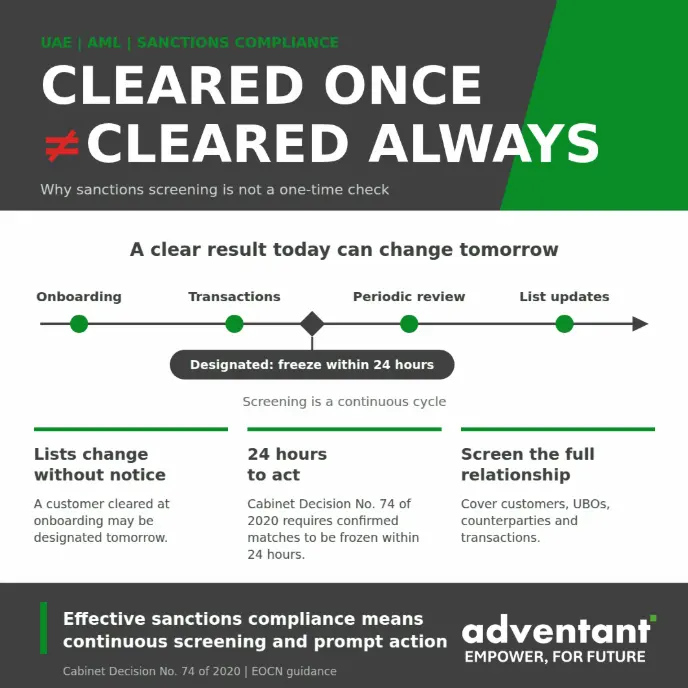
At a glance
- Lists change without notice: a customer cleared at onboarding may be designated tomorrow.
- Screening is a cycle: onboarding, each transaction, periodic review and every list update.
- Cover the full relationship: customers, beneficial owners, counterparties and transactions.
- When a match is confirmed, UAE targeted financial sanctions rules require funds to be frozen without delay, within 24 hours, and the authorities to be notified.
The detail, step by step
Screen at onboarding
Check the customer, their beneficial owners and authorised signatories against the UN Consolidated List and the UAE Local Terrorist List before the relationship starts, and record the result and how any possible match was resolved.
Screen each transaction
Counterparties, intermediaries and the details of a payment can introduce a sanctioned party that was never part of the onboarding check. Screen the parties on the transaction, not just the account holder.
Re-screen on a periodic review
Customers change names, ownership and directors. A periodic review that re-screens the current picture catches changes the customer did not tell you about.
Re-screen on every list update
Lists change without notice. When the UN or the UAE updates a list, re-screen the whole customer base against the change, not just new customers. Your screening tool should support this automatically; if it does not, the gap is yours.
Act within 24 hours on a confirmed match
Under Cabinet Decision No. 74 of 2020 and the Executive Office for Control and Non-Proliferation (EOCN) guidance, a confirmed match must be frozen without delay, within 24 hours, with no prior notice to the customer, and reported to the authorities. Check the current published text for the exact reporting steps for your sector.
- Freeze the funds or assets and block the transaction.
- Report the freeze and any attempted transaction through the required channel.
- Do not tip off the customer.
Keep the evidence
Keep the screening logs, the list versions used, the alerts and how each was resolved, and the freeze and reporting records. This is how you show a supervisor that screening is continuous.
Mistakes to avoid
- Screening once at onboarding and treating the customer as cleared for the life of the relationship.
- Not re-screening the existing customer base when a list is updated.
- Screening the customer but not beneficial owners, signatories or counterparties.
- Discounting a possible match without recording the identifiers used to rule it out.
- Not knowing how quickly the business could freeze funds if a match were confirmed today.
Evidence to keep
- Screening logs with dates, list versions and results for every customer.
- Records of re-screening runs triggered by list updates.
- Alert files showing how possible matches were investigated and resolved.
- Freeze and reporting records for any confirmed match, with timestamps.
Questions answered
How often should customers be screened against sanctions lists?
At onboarding, on each transaction, at periodic reviews and whenever the UN Consolidated List or the UAE Local Terrorist List is updated. A customer cleared at onboarding can be designated later, so screening has to be continuous.
What must a business do when it finds a confirmed sanctions match?
Freeze the funds or assets without delay, within 24 hours, without warning the customer, and report the freeze through goAML within five working days. Check the current guidance for the exact reporting steps for your sector.
Which sanctions lists must UAE businesses screen against?
At a minimum, the UN Consolidated List and the UAE Local Terrorist List. Registering with the Executive Office for Control and Non-Proliferation provides notifications when those lists change.
Is a possible match the same as a confirmed match?
No. A possible match needs investigation to decide whether the customer really is the listed person. Record how each possible match was resolved, and treat it as confirmed only when the details match.
Where Adventant can help
General information only, not legal or compliance advice. The examples and figures are invented for illustration. Your obligations depend on your activities and your regulator, so check the current rules that apply to you or speak to Adventant about your situation.